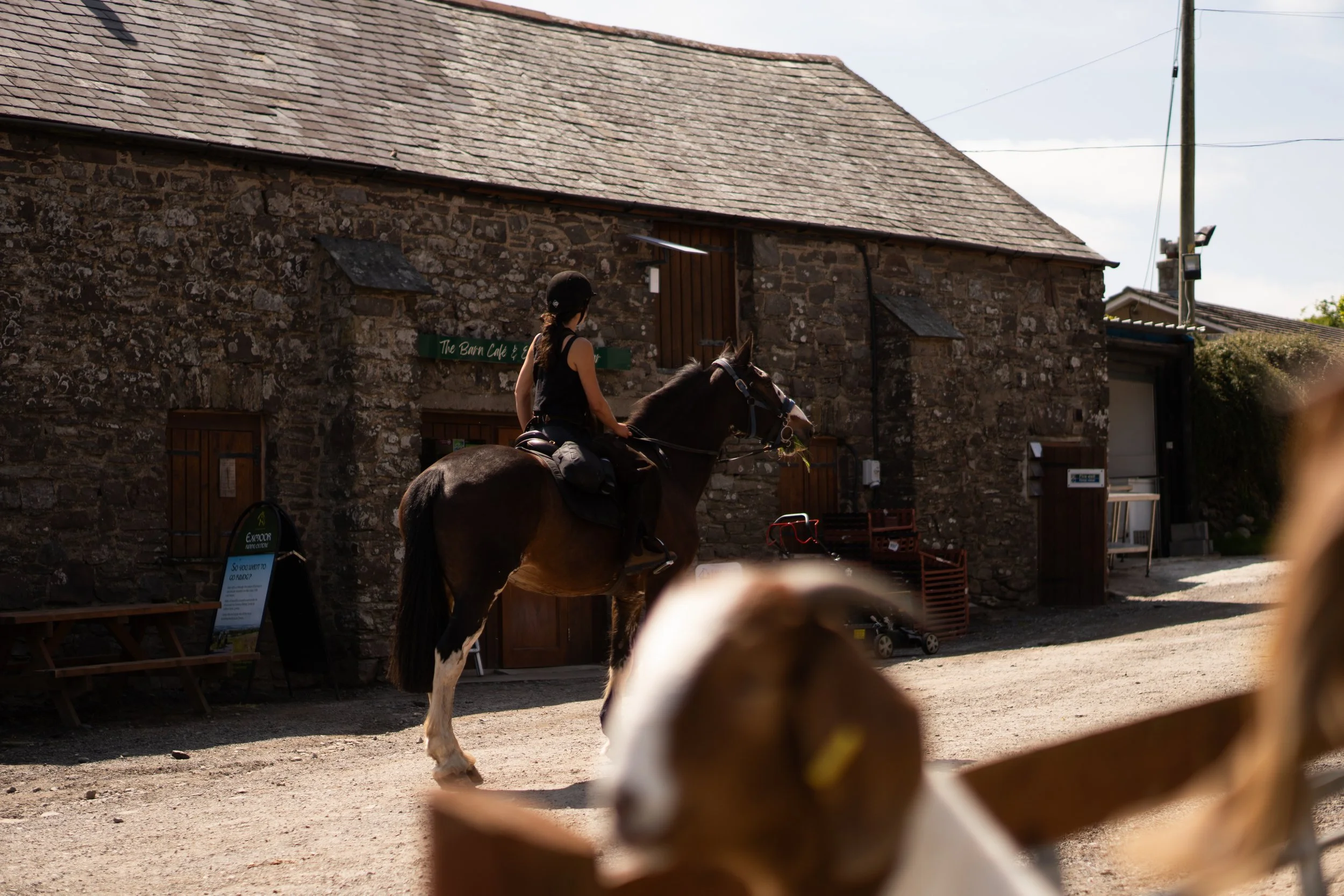
Exmoor National Park, June 2025.
The Usung Hero of the West Country.
By Sophie Lillie.
While most of the British countryside whispers, Exmoor bellows! Summoning sloshing mires, echoing hollows, and the wind’s inexorable yawn across the high tors. This gnarled terrain- scorned by millennia of tide and tempest, has been shaped by the labour of man and horse, through ploughing, peat-cutting, timber-hauling, and cattle-driving. Riding Exmoor’s bridleways has offers a visceral sense of the land and its stories..
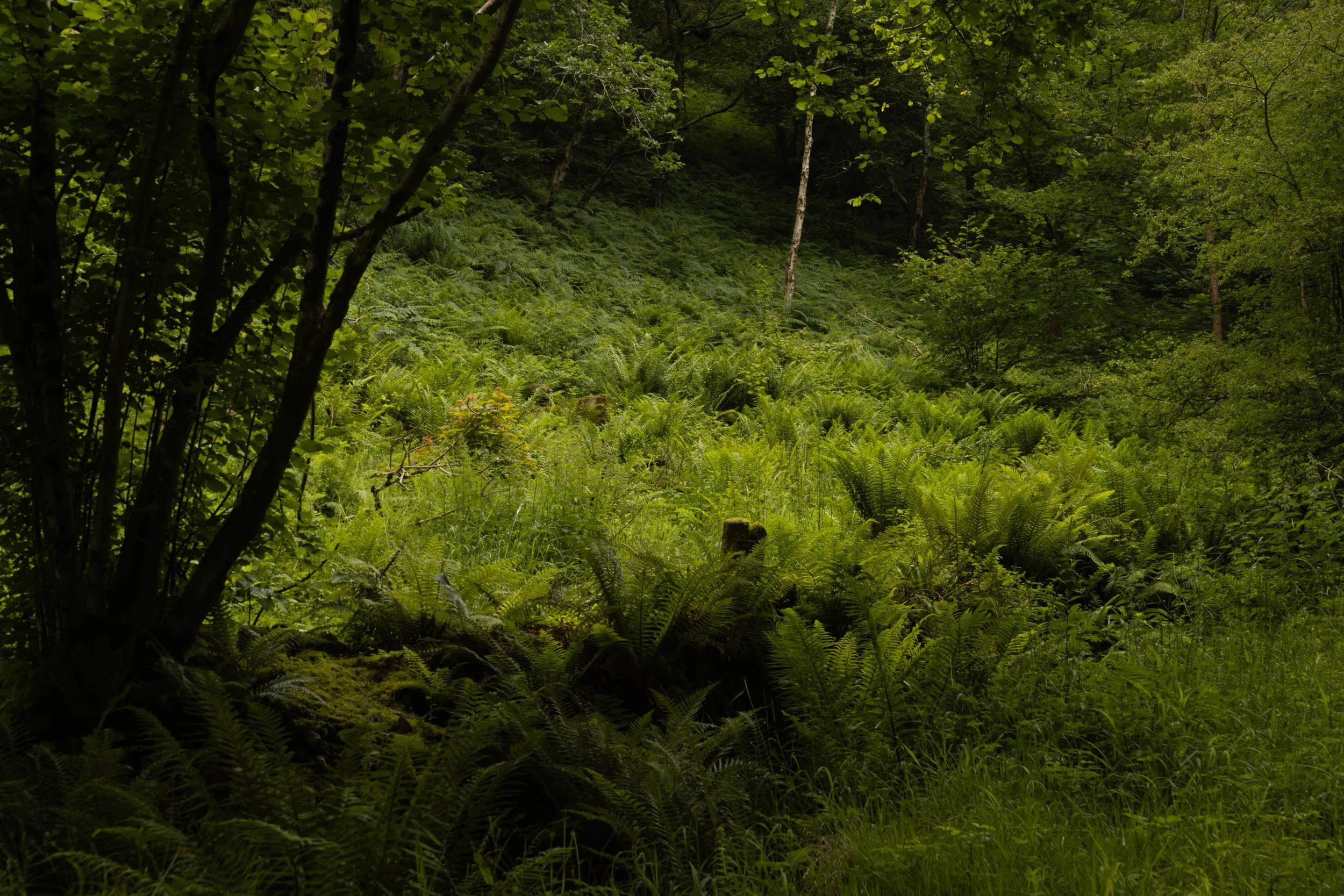
How is this England?
I ask myself as I wind my way toward Charlotte’s farm on the northwestern edge of the park. I catch my first glimpse of Exmoor rising like a forgotten Eden above the Bristol Channel, vegetation spilling down its spray-lashed cliffs. Nearby, the Romantic poet Samuel Taylor Coleridge reimagined the biblical story of Cain and Abel while wandering the Valley of Rocks, a place where granite logans stand as relics of Druidic lore. This hagbound landscape stirred Coleridge’s vision of the forbidding ‘Land of Nod,’ which he sets against Exmoor’s arcadian valleys ‘garden bright with sinuous rills’ revealing how beauty and bleakness coexist here.
Charlotte, a young, quad-bike-straddling mother of two, answered our ‘plea for a horse’ with the generosity typical of rural folk. Hearing our story, she entrusted me with her prized mount. Two years ago, I couldn’t sit a horse without nerves rattling through me. Now, I’m settled in the saddle for my first solo trek with Danni (co-adventurer) meeting me at certain check points along the route, critically supporting us with aid and praise. A quiet pride swells in me, born of every bolt, tumble, and tear, that paved the way for me to be out here on this horse, alone.
Meet Bud..
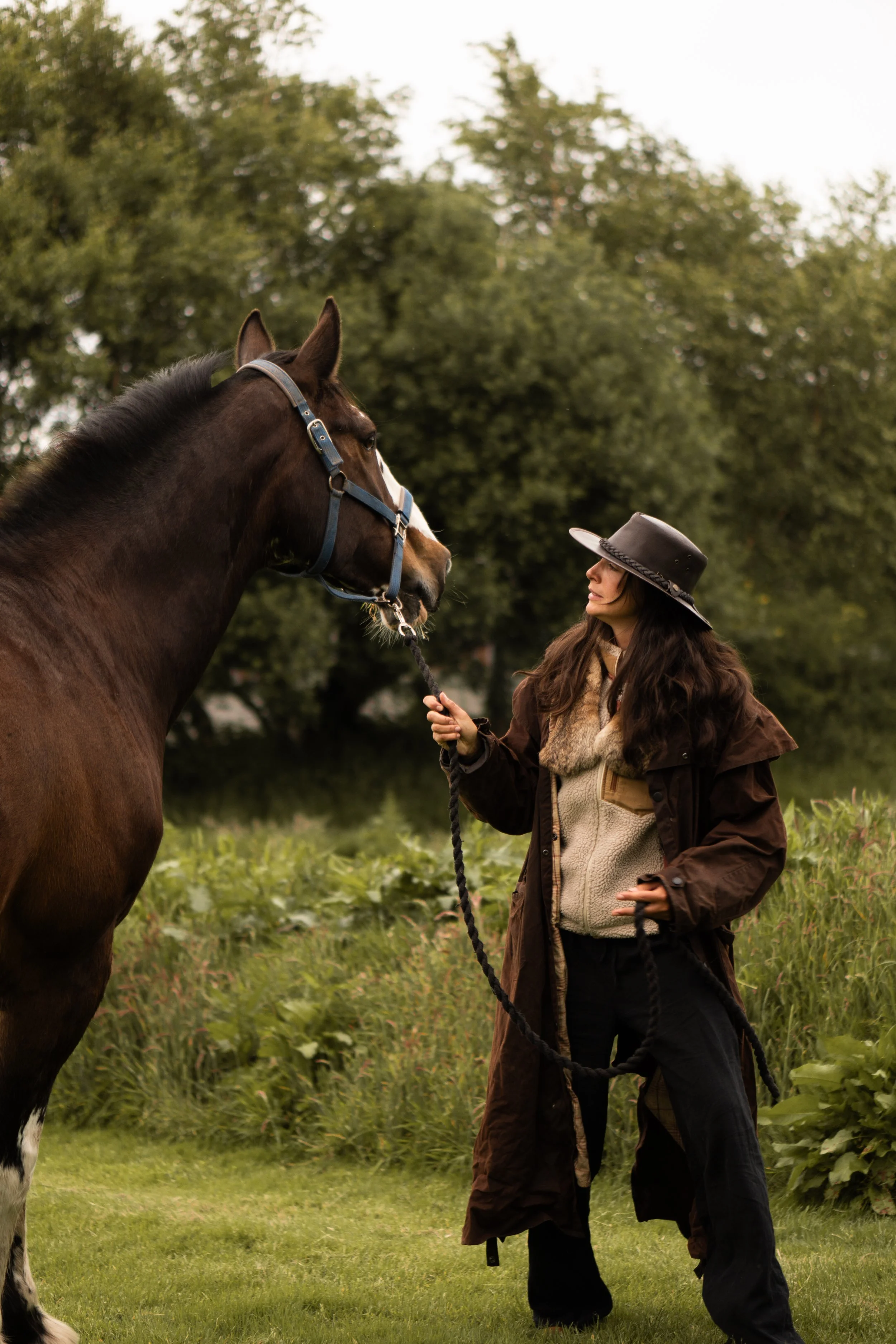
Short for Budweiser. A sleek half-Clydesdale, half-Thoroughbred mare, now doused in citronella and packed-up to the gunnels. She’s proud, and rightly so: sharp, resilient, and extremely sassy. The kind of horse that would thunder you into battle like a titan. What she lacks in humility, she makes up for in strength; trail hardened and unerring under pressure. Bud, understandably, was reluctant to part from her herd. But her wariness began to ease after our first test: an irksome detour forced by a road closure, leading us over a narrow stone bridge (scarcely wider than a smuggler’s cart) while the valley echoed with the clamour of machinery. I kept steady, and Bud, true to form, held her nerve. We pressed on, passing Roman fortlets, weathered sandstone outcrops, and the tidal pools of Woody Bay. On one side, the path dropped into an evergreen, Amazonian-like gorge-choked by mist, before collapsing into the restless waters of the Severn Estuary. After an unrelenting procession of hills, we reached camp, where Danni was readying hay and water. Bud had a stable beside the field, but Danni couldn’t resist tying her up nearby, wanting her to feel the nearness of those semi-familiar.
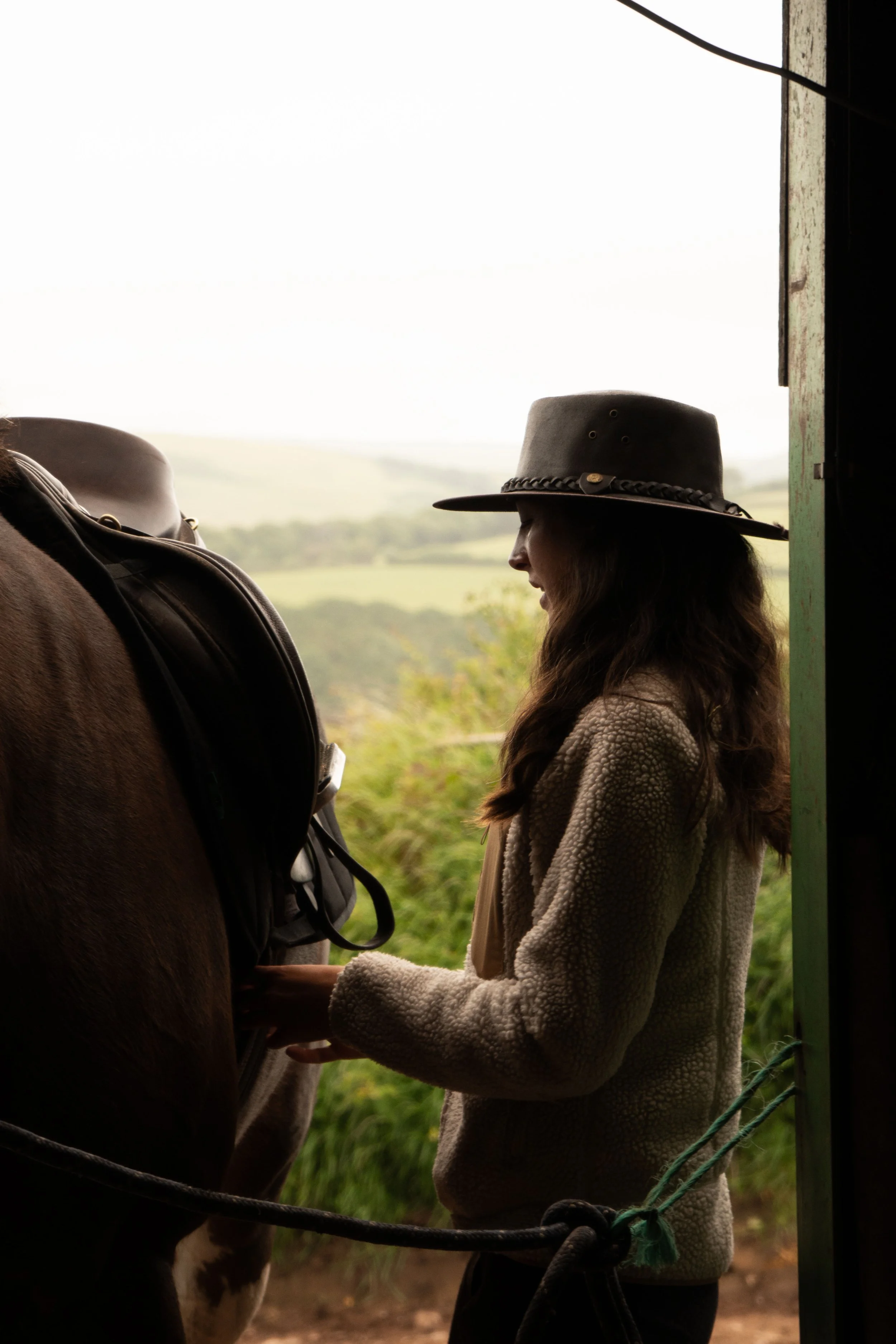
Commoners
The morning was ablaze with sunlight and the air thrumming with insects, a pulse that seemed to pass straight into Bud, A few playful rears later and together Danni and I managed to temper her. Once Bud found her cadence, we crossed the softly rounded hills of Woolhanger and Furzehill Common. As we moved across the moor, I was reminded of how the bond between man and horse is inscribed upon this landscape. A connection forged by generations of toil and tradition. This relationship is rooted in the ancient right of ‘Commoning,’ protected since the Magna Carta of 1215, ensuring that even those without land ownership could live off the earth and uphold rural traditions. One of the most wholesome expressions of this heritage lies in the hill farmers who continue to tend the iconic Exmoor pony herds.In recent years, common land has returned to the spotlight. From the legal fight to uphold wild camping on Dartmoor, to the deadline imposed for recording rights of way, groups like Right to Roam have been instrumental in challenging the notion that nature is a playground reserved for the landed elite. As one of their representatives put it, access to common land is “our birthright which brokers our connection to the land and the stars.” With the High Court upholding the right to wild camp, and the government scrapping the deadline on recording rights of way, recent rulings mark a hopeful shift in the fight to preserve common land for the common people. After crossing the open commons, we found sanctuary on the Duredon Farm estate. Bud settled into an old bull pen, now a humble stable, completely unfazed by the heavy-breathing tanks flanking her on either side. As night fell, so did the rain, a sudden deluge we hadn’t anticipated.
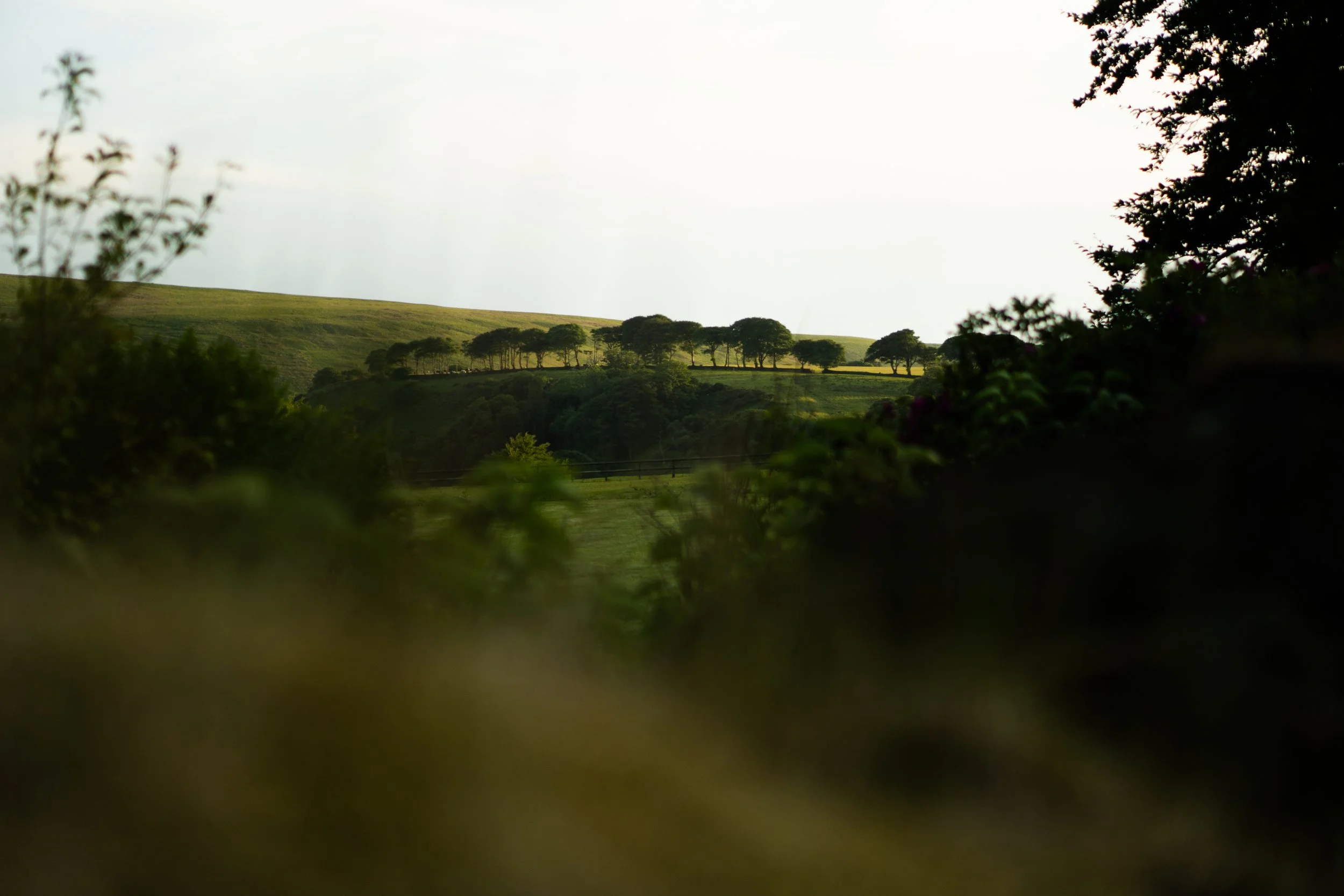
Bogs
Peat bogs, the reason I found myself thigh-deep in saturated earth, flailing in indignity. We’d been warned: never stray from the bridleways, or the mires will claim you. It wasn’t that I ignored the advice; I simply couldn’t follow the tracks. The previous night’s torrent had rendered the landscape completely featureless. As I wrestled with the clinging mire, Conan Doyle’s words echoed in my mind “a tenacious grip plucked at our heels, as if some malignant hand were tugging us down into those obscene depths” Yet, this wasn’t malevolence, just the moor’s senior authority, reminding me that here, I was decidedly out of my depth.
The lesson in humility continued. After the minor triumph of opening our first gate together, no small task given Bud usually wilted the moment I reached for it, a herd of cows came sauntering over. At first, they were merely curious, but their nosiness quickly tipped into chaos. I barked at them and, with Bud’s help, launched a bluff charge. Miraculously, it worked, and we pressed on across Brendon Common, a new layer of trust hewn between us. The thrill of bog swims and stampedes gave way to quieter miles as we wound beneath low-hanging boughs, meandering through a tree-lined glade in the Doone Valley. We rode alongside the East Lyn River as it hurried toward the sea at Lynmouth, its moss-furred stone banks flanked by steep combes ablow with pink campion and foxglove.
As we neared camp, a faint clinking broke the stillness. I hopped down to check Bud’s shoes and sure enough, one was hanging off. With dusk creeping in, we limped on and, by some stroke of luck, stumbled upon a pub, I tapped into the Wi-Fi and sent out a call for a farrier, but no luck. The only option was to make camp and head back at first light.
Exmoor Mafia
We woke to the sound of Bud neighing, likely greeting a fellow camper or calling in hope of breakfast. We’d pitched close, within earshot of her fenced pen, graciously offered by Ray, Ray Floyd (of the Floyd family, who, as we were beginning to realise, seemed to have their name etched across half of Exmoor.) Ray was a modest sort, unassuming and full of rural charm. As far as local dynasties go, I’d vote Floyd. With Rays help, we got hold of Graham, a farrier who, though initially prickled by the last-minute ask, turned up with quiet efficiency and, in the end, refused payment. Call it chance, providence, or some flicker of cosmic favour but that morning, the hoof was shod.
We bid Danni farewell and set out for the final leg across the moor, this time over Stock Common. The air was heavy and expectant, and then without warning, the heavens split. The rain came, and with my phone nearly flat and the bridleways blocked, I found myself in a right pickle. Sodden, half-blind with drizzle and fumbling with damp OS maps. Bud could smell the home stretch. She grew testy, sensing the end before we’d earned it. Every time I stopped to scout a path, she danced, keen to barrel forward. There was a lot of dead-ending, backtracking and second-guessing. By the time a sign for the familiar Hunters Inn came into view, I was so relieved I gave up resisting Bud, and let her march ahead. She clattered down the hills and root-choked woodland paths with hardly a pause. I had to hop off more than once to save my ribs. But I understood. She wanted her kin. She was nearly home, and after everything, that mattered more than manners.
Last Light
The last light spilled across the stables, ethereal and lambent. I stood in the hush, the scent of horse sweat and damp clothes thick in the air and reminisced over the last week. My first solo trek. A thing that once felt so distant. I was told that I didn’t have the background or the bearings but here I was, blistered, and brimming. I hope this story becomes part of someone else’s arsenal. A reminder that what feels unreachable is often just unstarted. And Exmoor was the teacher. A place still breathing in the old tongue. A land of drift and peat and granite bones. Of bridleways once trodden by drovers, smugglers, and saints. So many bypass Exmoor, chasing the gleam of the Cornish coast or the easy charm of South Devon. Let them. What’s here is rarer: a humble, hardy treasure of the West Country.